Lithium cells bulging - what are the opinions?

Jip …

Axpert move see … :laughing:

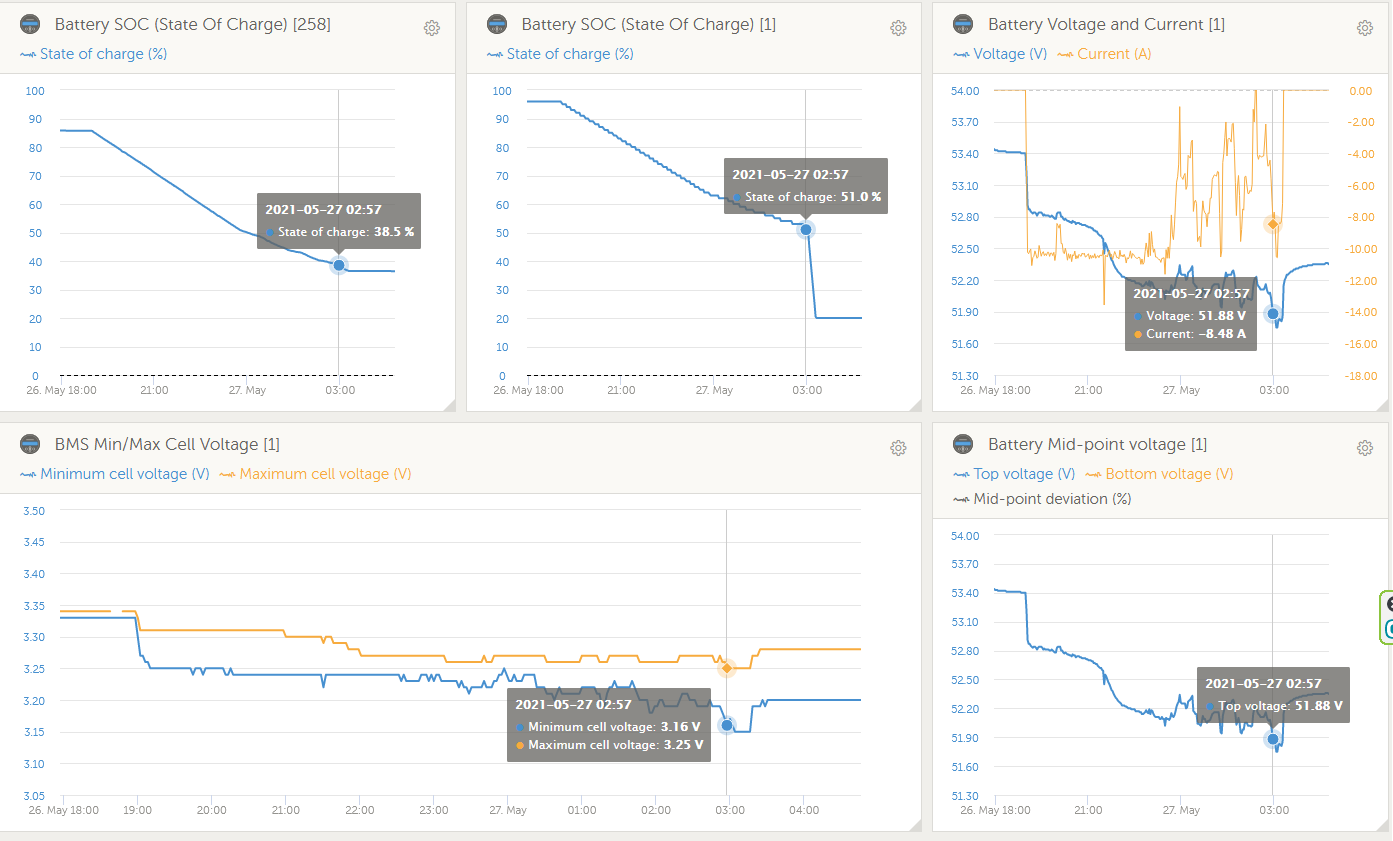
On a serious note, as long as ALL the cells behave, one can trust the BMS SOC, largely. But the BMV is more accurate ito coulombs and I’m going to stand by that statement till I see with my own eyes the difference.

With the new 280ah cells, even if I replace just 2 cells, watch, the BMV and BMS SOC will be close as damn again …

I disagree. The BMS is more accurate. With that one low cell in there, you’re going to run out of juice much sooner than the coulomb counter thinks. The coulomb counter is blissfully unaware that there is a spanner in the works. The BMS is closer to reality.

I said:

Unless someone does a check/test/test methodology/data analysis, it is going to take a lot of “talk” to convince me that a BMV shunt is less accurate than a BMS shunt.

And the moment anyone breathes volts in the same sentence as SOC, all I hear is that other forum and that other inverter and the arguments held there about volts and SOC. :laughing:

Just wait for 18 x 280ah cells … next import it would be so.
Then anyone can access my data and do the checks, comparison, or whatever, to compared BMV with BMS, as the BMV stays, finish en klaar.

Till then I have 2 cells I want out … they are causing the drama.
Me having had to forget about the “warranty” from the supplier.

1 Like

This is the value of having balanced cells.
The class can only progress at the speed of its naughtiest pupil.

They WHERE balanced, till that week with the weather intervening.

Fixed: This is the value of having Grade A balanced cells … with a cell or two spare on hand just in case.

1 Like

Let me try and explain it this way.
There are very few people that will argue with this statement. The BMV shunt is most likely more accurate than the BMS shunt.

The problem with this statement is that we are not talking about shunts here. We are talking about the state of charge.

In the old days of lead acids you had very little information on the battery to work from. The only way was to measure the battery voltage which worked, but adding a shunt to measure the current flow and voltage was much better.

Then came lithium batteries and people tried to also use the battery voltage measurement. This does not work for lithiums at all. Lithium cells voltage curve is very flat, so trying to measure the voltage over a battery with many cells is a disaster.

To solve this BMS came to the rescue. The BMS use a shunt to measure the current flow but also looks at each cell in the battery and balance that cell.

Note here the difference is between looking at battery voltage (bad) and cell voltage (good).
And that is why the BMV just cannot ever compete with the BMV. They are totally different equipment made for different battery types.

@TheTerribleTriplet & @Louisvdw,
I think that you both are saying the same thing in different ways.

It boils down to a rogue cell affecting the capacity of the entire bank that the BMS knows about but the BMV doesn’t.
Without that rogue cell, they would correspond. Or if you told the BMV that the new battery capacity was now what be BMS says it is, I think they would correlate.
On the other hand, the real fix is replacing those cells as @TheTerribleTriplet says.
But he wouldn’t have known about that without the BMS as @Louisvdw says.
The question is would @TheTerribleTriplet lived in blissful ignorance of this duff cell if he didn’t have a BMV as well?
Maybe, there is an argument that having both is still worthwhile because it identifies these things.

2 Likes

Thank you. Don’t diss a BMV. :wink:

Now that that “elephant” has been agreed upon …most BMS I’ve seen do not have a shunt. So there is that.

Wonder what the small 12v BMS would have done in this case … I don’t think I ever would have seen it, know about the problem BAR that my time to discharge would have dropped a lot, or I saw the cell/s dropping fast. Mmmm.

As per Phil. I would have been blissfully unaware of the problem until I realized my bank discharges in X hours vs expected Y hours, or I would have seen a cell volts dip by accident.

YES! Comparing BMV and BMS SOC’s pointed out a problem with a cell, or cells, near-instant.

I get this 100%:
BMS works on the current flow and voltage per CELL.
BMS works on the current flow and voltage of the BANK.

But also floating around in my mind is that:
Lithium banks do consist of lots of cells, I agree.
But so do lead-acid banks.
Each battery is made up of cells inside, making them 6v or 12v “holders”. So if a cell in a lead-acid battery dies, that battery is “dead”, and the SOC “in sy moer” too.

So in my view, apples for apples.

What irritates me the most, the coulombs counted by the BMV vs the coulombs counted by the BMS, is not in sync on a balanced bank … and I understand the reason being the BMS works the volts per cell, BMV on the volts of the bank, and cells act slightly different cause each one is measured.

So, in conclusion, Is this summary correct:
If you have a BMS with a shunt and one or more cells are out of whack, the BMS calculates the potential SOC of the bank, by counting the coulombs going into the BANK, seeing each cells volts, and if a cell, or cells, are out of whack, based on those cell/s volts, “knows” that the bank was not fully charged, therefore the difference in SOC?

Ps. Cause a BMV would have given a similar result on a lead-acid bank if one cell in a sealed battery has an issue. One would just never know the cell number, maybe the battery due to heat or balancer on it or whatnot. Apples for apples, ja?

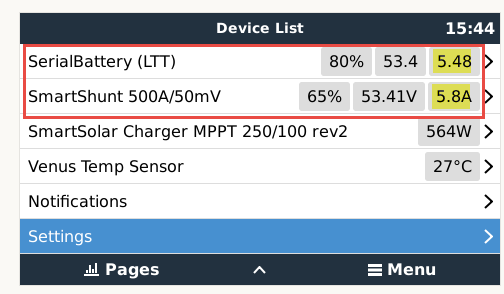
THIS annoys me: The shunts not measuring the exact same all the time.
Bank volts are most of the time on par. SOC close IF cells are balanced
image

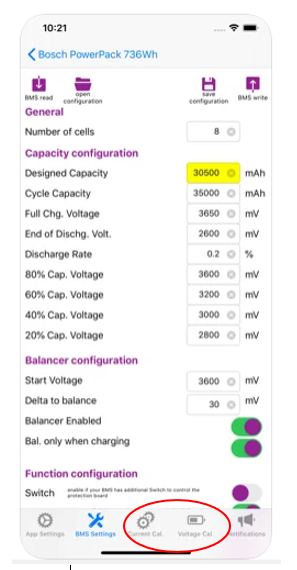
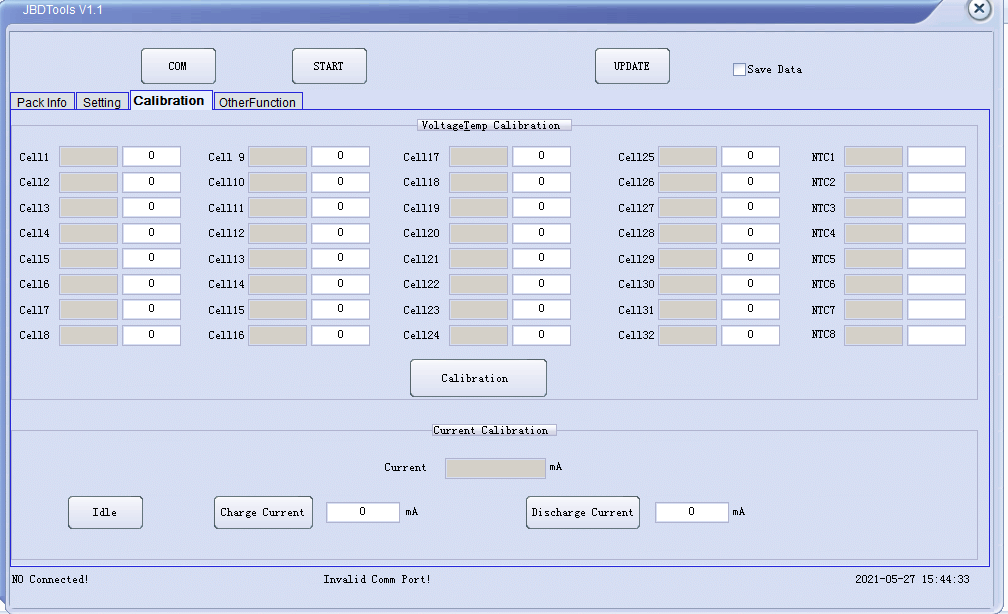
I think this part is an easy fix. In the app use the current calibration of the BMS and tell it to adjust to what the BMV is saying the current is…

1 Like

NOW we are cooking with gas!!!

Yes , the BMS knows there is an issue and adjust the SOC accordingly.

Then the BMV saved me weeks of looking and tampering … or till I figured to check the cell voltages.

Which makes me then state: A BMV, on a well BALANCED bank, configured properly, will give me a far faster heads up of any potential drama brewing, than running without a BMV.

Cost of lithium bank: 20 times more than a BMV.

Which setting would I look for?

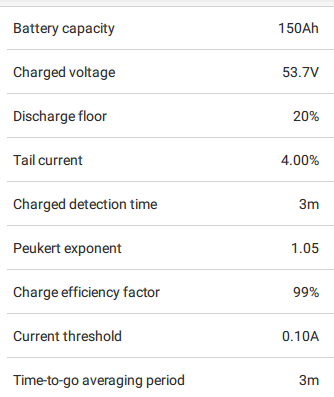
My BMV settings:
image

I am using the IOS app. It has a voltage and current calibration facility.
I assume it exists on the android version.

Nope, cannot find it. Let me see if I can get a Apple device to borrow.

I’ll be back.

PS. I did get they paid for app, not just the freebie version.

Give me a minute and I’ll tell you how to do it without a phone.

Edit: OK, go here and download the Windows PC version of the software, it has the calibration facility.
https://www.lithiumbatterypcb.com/smart-bms-software-download/

Got hold of an iPad.

Also have that software on my PC.

Right, let me get settled, then I’ll ask questions.

Cause methinks you may be onto something here … get the BMS/BMV to talk the same “taal”, BMS sorts cells, BMV sorts SOC, and if the two SOC’s are out of whack, “Houston, YOU have a problem”.

I haven’t used it the calibration tool on this app, I haven’t even physically got a BMS yet.
I just have calibrated many things in my time, so I know the principles inside out.
Give it a known value, the tell it to read that value.
Try an choose a sensible known value that typifies the range you want the device to be accurate in.
You will tell it a zero value (“idle”) and a charge value from the BMV, you can use a discharge value (by actually creating a discharge condition), or you can reverse the leads on the BMS and still use the value from the BMV.
To be more accurate you want to use a fairly high current that is typical of your highest charge or discharge current value to calibrate.
Using a small current to calibrate is not a good practice and can still cause values to drift apart at higher currents.
Voltages won’t vary wildly so calibrate them ( I wouldn’t, yours seem accurate already) at cell midrange values.
You can also calibrate the temp probes here.(NTC’s). I’d leave them alone, unless their inaccuracy is upsetting you.

That’s kinda my point. When the cells don’t behave, the BMV is wrong. Badly so. And this is arguably when it matters to not be wrong :slight_smile:

When the cells are behaving, then perhaps I’ll concede the win to the BMV. It is a spectacularly good piece of kit, there is no denying that.