Personally I think the world, like in the Sci-fi novels, can do with cleaner energy, whatever that may be one day.
There are some exciting possibilities though. Plant-based materials over plastic, for example. But you can also make plastics from plant material (bio-plastic). The challenge, of course, is making such plastics durable, but also recyclable… or at least disposable in a clean way. Since it is plant material to start with, you can in theory burn it, since that returns to the atmosphere the carbon of the plant that grew last year, not the one that grew a million years ago.
But, I know nothing about this. I’ve heard of it. I imagine it will be very expensive in the beginning.
We hope that it will happen and I am in no doubt. But they need to manage it delicately.
The only close comparison I can offer was the CFC crisis which I thought was handled very well. That one was quite simple since all that needed to be done was to pressurise the manufacturers to stop making the nasty stuff. But they would still be in business making the new refrigerants so no problem there.
The trouble with the ICE industry is that the transition is going to be a lot more painful.
1 Like
Interesting and well done!

From flat to full in 30min … that is really cool!
Same time as a stop filling with diesel, the “others” going into the shop.
There’s a quote that popped into my mind today.
“Research is what I’m doing when I don’t know what I’m doing.”
Werner von Braun said that.
1 Like
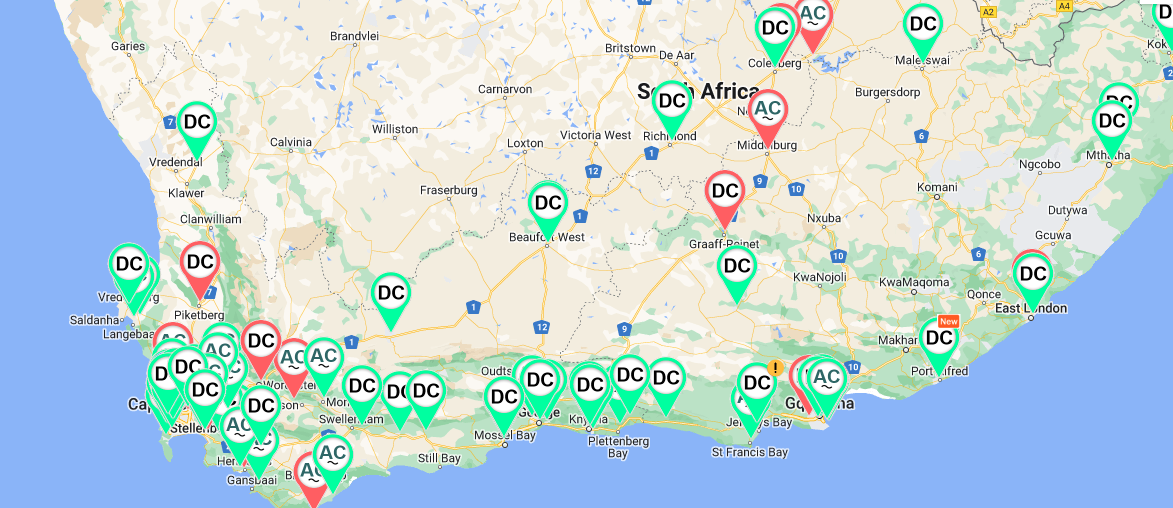
I’ve been following them for a while now. I learned about the company through a family member with land in the Northern Cape (around Keimoes area), who was considering a partnership. Because that is what they do. They don’t buy the land. They strike a deal to use the land in return for a part of the revenue and/or the energy. And if you are already running a farm stall on that land, it makes it even more of a no-brainer.
They say they aim at getting the first 120 stations up within 18 months. That is ambitious! And exciting.
Also sounds like the N2 is last in the plans, but at least the N1 up to Springbok is on the cards. Maybe the more common presence of gridcars chargers on the N2 has something to do with that 
1 Like
If they can charge a EV in 30min, it takes the same time for a ICE to be filled and the people climbing out.
Another benefit I see, you are forced to take a break, to recharge.
1 Like
There is one constraint, and that is that refueling is generally done by sending the family ahead to perform the rites of ablution and check out the snacks so long, while dad fills up the car, a process that takes anything between 5 and 15 minutes depending on where you are and how busy it is. Then the car is parked lapaside while you finish these actions, pay, and go on your merry way. With an EV, you will park the car and it will occupy the refueling station for the entire 30 to 45 minutes. So your ratio of chargers to cars will have to be higher than pumps to cars. At least three times, and the Easter weekend will still be a disaster.
But, I do believe that will be solved over time. And right now, you are absolutely right, and it is something I have been saying for a while: The average stop, for non-crazy people, is not just 5 minutes. It is at least 15. And extending it to 30 and even 45, a forced break in other words, has been a good idea long before EVs came on the scene.
I see what you did there…
I used to suffer from get-there-itis. My wife convinced me that the journey needs to be enjoyable too.
Jip. In a 1.6Gli, took me 1h 8min to travel 200km. No jokes. Over and over I did that. Was exhilarating.
But o’boy, if the trucks I just overtook 10km earlier pass me again whilst refueling, I get annoyed. Move move move.
Today … 90-110km/h … Ou man met sy ou kar.
At times I drive behind a “fast” moving truck now.
After the latest huge maintenance spree on Suzy, she now does 11.78km/l in city/open road when I drive using the brake pedal like “it costs money”. Differently put, I drive like a little girl.
So today, fuel stops for 30-45minutes are “fast” compared to “back then”. 
Whole new dynamic. So I thought, mmmm, plan the stops. See a open charging station on the way, pull in, top up. Why drive till I have to recharge and then wait in a que?
Somewhat of the reverse happened to me. The last maintenance, which was one of those things where it was a lot of money for what is now very little mileage in a year, was to replace shock absorbers and strut mounts all round, which was almost 12k. The upside of that, as anyone who has done this work knows, is the car drives like new. It runs 160km/h without getting all floaty as it did before. So… I do try to keep to the posted speed limit, mostly, but suffice it to say, now that three quarters of the driving is electrical, I feel like I don’t have to concentrate so hard on fuel economy on the holidays. I stop for longer periods, and I drive as fast as I am allowed.
I remember many people telling me, in the old days, how they drive only 100km/h, but they make the same time as the other guys because they stop less. I now consider that a less safe way of doing it. Go 20km/h faster, and stop a bit longer. Or at least, don’t feel guilty if you do!
1 Like
Story time:
So Suzy had steering issues. Replaced every single part in and around the steering. It was time for maintenance.
Close, but just just no cigar.
So I thought, hold on, she is 25, had shocks like 10 years back. Lets swap that.
Understand, it is 8 nuts and bolts to replace all 4 shocks. No MacPherson struts either. just a shock totally easily accessible.
Then the fights started.
O sir, that is a BIG job, days work. R6k for all 4.
Quote after quote similar vain.
Big job, my arse. “Julle vat gat” I told the one business.
So I started asking questions. Mechanic says labor 1-2 hours max for all 4, plus balancing and alignment, if you supply the shocks.
Balancing and alignment, no use one works there and not use the opportunity.,
Holy smokes. The cost for 4 … internet prices was like ±R4k for just the shocks.
Then, having learnt the right questions to ask, who to speak to, got the entire job done in under 2 hours for under R4k, incl shocks, balancing and alignment.
And I saw the cost price of the shocks. Bugger me.
They see us coming a mile away.
Yes, the days where a strut was under 1k is over. You’re lucky if you get away around 1.5k per corner. Add labour, add strut mounts (if the car has them, which most non-bakkie platforms do). You’re not getting away under 6k. Forget it. Inflation has caught up with us.
What I don’t get, no wear on the tires, nor feathering. Tires are perfect over after 10 years.
No bouncing driving dirt roads either.
Nor over speed bumps (at speed at times). Just watch your head and the roof … “sy kan bokspring”.
Only a slightly floaty feeling on certain roads IF you know the vehicle. Wife was astounded that there was a problem.
Yet the shocks are gone, every 10 years or so. No resistance whatsoever when they are off the vehicle when you test them by hand.
Cannot explain it.
On my car, I had the additional issue afterwards of hearing a slight metallic rattle. Oh, I know this, I told myself. It is the exhaust shield. Happens to all Toyotas made the last decade or two, vibration, metal fatigue, the thin metal shears off at the bolt. A large washer puts it right. I get under the car… exhaust shield is fine?
Turns out during the strut replacement, the metal brake shield of one of the front wheels was pushed in slightly, and it vibrates against the disc every so slightly. An acceptable result of a strut replacement. I pushed it back, and it is all done.
Not long after I did a brake pad change on the i3. Man, I know, people make fun of German engineering as if it is always complicated, but not on the i3. What an absolute pleasure. Wasn’t even all that expensive for brake pads (full set plus the wear sensor was under 2k, from the dealer too). So different from what is clearly a budget no-nonsense-but-sometimes-you-have-to-bend-it-back setup on the Toyota
Read the article below, quite interesting. Ties back to EV recharging habits for the future.
Two things that stands out for me:
- Suzy gets other side not far behind speeding drivers.
- Leaving 4/5am for a holiday trip, bugger me but no. Seems the data confirms that.
So with the above in mind, with long trip EV recharging, here is the rest:
https://businesstech.co.za/news/motoring/804317/the-biggest-road-trip-mistakes-that-south-africans-make-including-an-early-start
Thats why you should be leaving at 2am
I try to leave between 2 and 3 in the morning if we’re driving down to the western cape from the highveld.
1 Like
That’s actually the worst time. It’s the low point of the circadian Rhythm, when your reaction time is at its worst. When I still did the Cape Town → Windhoek trip in a single sitting, I would leave at 4AM, which was something I learned from my father. My father was however one of those “drive slower but don’t stop” people.
I suppose it also depends WHERE you are leaving from. Leaving from Cape Town area towards Namibia, the road is absolutely dead quiet the first 300km or so. Conversely, returning from the Southern coast, if you leave early you’re alright, if you leave just before noon, you get stuck in slow traffic at Stilbaai and then you drive in traffic all the way from there until you hit Gordon’s bay.
But for the most part, leaving a day late absolutely helps. I can also confirm that if you are in Stilbaai, on the first of January you’ll be stuck in traffic trying to get to the local Spar. On the second of January, the entire place returns to normal, and you notice all that’s because all the GP cars left on the first.
I do my best to avoid Stilbaai from now until after the first week in January. We have family there and I love holidays there. But during this period its not fun… except if you like crowds
Some people, my wife, father, son are early morning people.
So this hold true for them.
Myself, daughter, my mother, we “wake up” at 10pm.
Worst time for us, early mornings.
It is a “thing” as I learnt recently.
Having travelled extensively nationally myself long ago, I learnt the following three facts:
- I have x hours of optimal travelling time per day.
- Said optimal hours do NOT include early am mornings. After 10pm, the road is clear.
- If you drive a lot over long distances you discover the “rhythm of the road”. You notice lots of cars/trucks you need to pass. Drive “thought them” until you get into the lull between. Lke “waves” of traffic, little to no cars/trucks. Just you and the open road. Stay in those “dead zones”.
… till you realize one day you travel at such at a good clip that you are going to catch the next “wave”.
1 Like
An old friend of mine is the daughter of the then security police officer who arrested Banda in then Nyasaland. She told me that the security cops always opted for 2 to 3 in the morning if they had the option, because that is when the target would most likely be disoriented.
1 Like